
Quick Summary
Addressing persistent HVAC odors and microbial buildup in Central Texas requires thorough mechanical source removal rather than superficial chemical sprays, making proper air duct sanitizing in Brushy Creek essential for home ventilation systems. Nova Air Duct Cleaning Service Austin explains that effective sanitization depends on rotary HEPA negative-air extraction followed by targeted, EPA-registered antimicrobial treatments applied directly to clean evaporator coils, plenums, and duct liners. Readers will understand how to tackle underlying moisture issues and can contact Nova Air Duct Cleaning Service Austin to schedule an inspection and request a free estimate for air duct sanitizing in Brushy Creek.
Air Duct Sanitizing in Brushy Creek: Addressing Persistent Odors
When you switch on your air conditioner during a humid Central Texas summer and notice a musty smell, your ductwork may contain trapped moisture, dust, pollen, or microbial growth. For homeowners considering air duct sanitizing in Brushy Creek, addressing odors requires more than spraying a deodorizer into the return vent. Aerosol sprays only temporarily mask smells, while wet chemical fogging over dirty ducts can create further issues.[2]
Duct cleaning and chemical treatments should be approached with care. The U.S. Environmental Protection Agency (EPA) notes that air duct cleaning is generally recommended on an as-needed basis rather than on a routine schedule, and that existing evidence is insufficient to draw conclusions about broad health, indoor air quality, or HVAC efficiency benefits. The EPA also advises that chemical treatments should only be used when specifically warranted and label-approved for HVAC components after mechanical debris is addressed. Contact Nova Air Duct Cleaning Service Austin to assess your system and request an estimate.[1]
Why Chemical Sanitizing Fails Without Mechanical Cleaning
Applying an antimicrobial fogger into an uncleaned HVAC system can be ineffective. Chemical sanitizers cannot properly reach duct surfaces if blocked by layers of dust and debris. Instead, the liquid settles on top of the debris layer, wetting it down without eliminating the underlying source of odor.
Dust and Debris Accumulation
Residential HVAC systems can accumulate fine airborne dust, construction particulate, and pollen over time. This particulate can bypass basic filters and settle along the ridges of flexible ductwork and inside mixing plenums.
If a duct system is treated with liquid sanitizers before particulate matter is vacuumed out, the liquid can mix with dry dust to create a damp residue along seams and interior surfaces. This added moisture can encourage further microbial development once the system operates, potentially worsening odor issues rather than resolving them.
Source Removal Must Come First
An EPA field study across nine single-family homes demonstrated that mechanical air duct cleaning alone did not substantially reduce bioaerosols and culturable surface microbial levels. When chemical treatments are considered, they are intended for clean surfaces rather than accumulated organic matter. Applying chemicals over contaminated ducts can introduce unnecessary moisture into the ventilation system.[3]
Federal guidelines from the National Institutes of Health (NIH) advise using containment barriers, proper ventilation equipment, and HEPA-filtered negative-air machines during HVAC duct cleaning. According to Nova Air Duct Cleaning Service Austin, thorough mechanical agitation combined with negative air pressure helps extract accumulated dust and particulate reservoirs before any appropriate sanitizing treatment is applied.[5]
| Cleaning Approach | Mechanical Extraction | Antimicrobial Step | Expected Outcome |
|---|---|---|---|
| Superficial Fogging | Minimal or unsealed vacuuming | Liquid chemical applied directly over dust | Damp residue buildup, clogged coils, and potentially returning odors |
| Mechanical Extraction + Targeted Sanitization | Rotary contact brushing with sealed HEPA negative air | EPA-registered, label-approved product applied to clean surfaces when warranted | Cleaner duct surfaces and reduced particulate reservoirs |
Which HVAC Components May Require Targeted Sanitization?
Need air duct sanitizing in Brushy Creek?
We’re available now — call for a fast, free estimate.
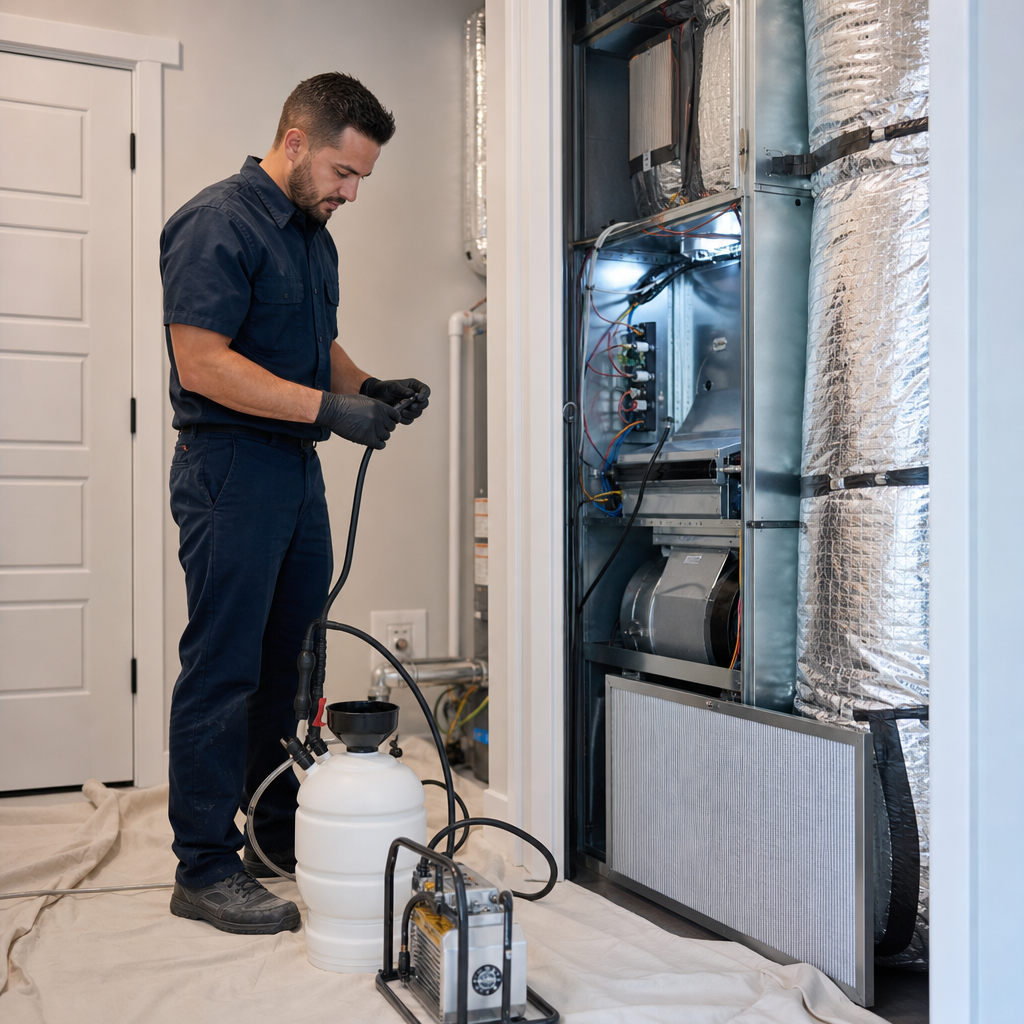
Sanitizing is not a generic spray applied indiscriminately through supply registers. To help address recurring odors when conditions warrant treatment, technicians at Nova Air Duct Cleaning Service Austin evaluate specific components where temperature swings create moisture.
Evaporator Coils and Condensate Drain Pans
Your indoor evaporator coil extracts moisture from the air during cooling cycles. As air pulls through the fins, airborne dust can stick to the wet metal. If the condensate drain pan drains slowly or backs up, bacterial slime and mold can form. Servicing involves mechanically washing the coil face and, where appropriate, treating components with label-approved antimicrobial solutions to help prevent odors from circulating into living areas.
Mixing Plenums and Flexible Duct Runs
Many residential systems use flexible ducting connected to a central sheet-metal or duct-board plenum. High attic temperatures can cause duct sweating if the insulation jacket is damaged. Technicians evaluate two key areas:
- Intact Duct Liners: When warranted, an EPA-registered, label-approved antimicrobial product may be applied to clean interior surfaces to help control microbial growth.
- Plenum Connections and Seams: Leaking joints pulling in unconditioned attic air should be sealed with professional mastic paste rather than standard duct tape to prevent outside humidity from entering the system.
Blower Wheel Assemblies
Blower motor fan blades can accumulate a layer of dust and pet dander over time. As these blades rotate, they can distribute particles down the supply line. Mechanically cleaning the blower wheel assembly removes this buildup, preventing clean ducts from being re-contaminated when the system runs.
What Does Air Duct Sanitizing Cost in Brushy Creek?
Because no public municipal pricing records exist specifically for Brushy Creek, actual costs depend on the size of your home, the number of HVAC systems, duct accessibility in the attic, and the level of contamination present.[4]
As noted by Nova Air Duct Cleaning Service Austin, professional duct sanitization is typically offered as a supplemental treatment following mechanical cleaning rather than a standalone service. Be cautious of contractors advertising whole-house cleaning for unusually low rates; these offers often involve superficial fogging without the proper HEPA extraction equipment needed to clean ductwork thoroughly.
| Property Type | Mechanical Source Extraction | Targeted Sanitizing Treatment | Primary System Challenges |
|---|---|---|---|
| Single-Story Home (1 System) | Full HEPA negative-air brush cleaning | Coil, plenum, and supply trunk treatment where warranted | Dust accumulation, pollen, pet dander |
| Two-Story Home (2+ Systems) | Zoned extraction per air handler | Multi-unit antimicrobial application where warranted | Attic heat gain, long horizontal flex duct runs |
| Commercial / Light Retail | High-capacity commercial negative air | Targeted system surface sanitizing where warranted | High foot traffic, heavy bio-load, continuous run time |
Frequently Asked Questions
What is the difference between standard air duct cleaning and sanitizing?
Standard air duct cleaning is a physical process that removes solid matter (dust, dirt, pet hair, and pollen) using mechanical brushes and HEPA-filtered vacuum pressure. Air duct sanitizing is an additional step where an EPA-registered antimicrobial solution is applied to clean interior surfaces when warranted to help control remaining surface mold, fungi, or bacteria.
Is air duct sanitizing safe for pets, children, and people with allergies?
When antimicrobial treatments are used, they must be EPA-registered and label-approved specifically for HVAC applications. Products must be applied in strict accordance with manufacturer directions. Occupants and pets are typically advised to stay out of the home during application and for a designated settling period afterward to allow adequate ventilation.
How often should HVAC ducts be sanitized in Central Texas homes?
No neutral authority has established a routine schedule for duct sanitizing in Central Texas homes. The EPA notes that air duct cleaning is generally needed only on an as-needed basis, such as following water damage, mold growth, vermin infestation, or substantial particulate clogs, rather than at predetermined calendar intervals.
Does air duct sanitization permanently remove mold and mildew odors?
Sanitization does not guarantee permanent odor elimination. While it may help neutralize microbial growth present at the time of application, odor control is conditional upon resolving the underlying moisture source. If roof leaks, standing condensate pan water, or duct leaks pulling in humid attic air remain uncorrected, microbial growth and odors can return.
Ready to address persistent odors and dust in your ventilation system? Contact Nova Air Duct Cleaning Service Austin today to schedule an inspection and receive an upfront estimate for your Brushy Creek home.
Need air duct sanitizing in Brushy Creek?
We’re available now — call for a fast, free estimate.
Sources
- Effectiveness of HVAC duct cleaning procedures in … – pubmed.ncbi.nlm.nih.gov (2001)
- DOHS Fact Sheet On HVAC Duct Cleaning – ors.od.nih.gov (2010)
- Research Agenda on Air Duct Cleaning – nepis.epa.gov
- Brushy Creek Sediment, Habitat, and Water Quality … – eec.ky.gov
- Air Duct Cleaning Services in the US Industry Analysis, 2024 – ibisworld.com (2026)
Frequently Asked Questions
How long does a professional air duct sanitizing appointment take for a Brushy Creek home?
A standard appointment combining rotary HEPA negative-air cleaning with targeted sanitizing typically takes 2 to 4 hours depending on the size of the home and system count. Technicians from Nova Air Duct Cleaning Service Austin inspect the layout first to provide an accurate timeframe before beginning work.
How long should occupants and pets stay out of the home during and after sanitizing?
Occupants and pets are typically advised to remain off-site during the application and for a settling period of 1 to 2 hours afterward to ensure proper ventilation. Nova Air Duct Cleaning Service Austin reviews specific EPA-registered product guidelines with homeowners to ensure a safe re-entry process.
Can flexible ductwork be sanitized without damaging the inner plastic liner?
Yes, professional technicians use gentle rotary agitation and controlled HEPA suction designed specifically to protect flexible duct cores from tearing. Nova Air Duct Cleaning Service Austin applies fine, label-approved antimicrobial mists that neutralize surface contaminants without saturating or degrading flex duct materials.
About the author
 |
Sarah Jenkins Sarah is an indoor air quality specialist and content writer with over eight years of experience in the HVAC and ventilation industry. Holding a B.S. in Environmental Science from the University of Texas at Austin, she focuses on educating homeowners and property managers about the impact of clean air ducts on respiratory health and system efficiency. Her writing combines technical knowledge with practical advice for maintaining optimal indoor environments. |
Dusty vents or weak airflow at home?
We’re available now — call for a fast, free estimate.
Call Now - Free Estimate