
Quick Summary
This guide explains how professional air duct sanitizing in Cedar Park tackles accumulated dust, attic moisture, and microbial growth to eliminate persistent musty odors. Nova Air Duct Cleaning Service Austin emphasizes that applying EPA-registered antimicrobial treatments is only effective when paired with prior mechanical cleaning to remove underlying debris. Readers will understand system pricing factors, critical HVAC components requiring treatment, and how to request a free estimate for safe, targeted sanitization services.
Air Duct Sanitizing in Cedar Park – Addressing Dust & Mold
If a home has a lingering musty smell when the air conditioner turns on, or if occupants experience indoor discomfort, the ductwork may contain accumulated dust or moisture. Environmental factors such as outdoor pollen, airborne dust, and high attic humidity can contribute to debris buildup and potential microbial growth inside air distribution systems.
According to specialists like Nova Air Duct Cleaning Service Austin, professional air duct sanitizing is sometimes used to treat microbial contaminants. When applied in accordance with product label directions, sanitizing may help reduce microbial residue on duct surfaces after thorough mechanical cleaning, though it is not a guaranteed fix for all indoor air quality or odor concerns.[1]
Quick Answer: What Is Air Duct Sanitizing?
Quick Answer: Air duct sanitizing is the application of an EPA-registered antimicrobial product directly into HVAC ductwork, which must strictly follow EPA label directions. It is performed only after mechanical cleaning has removed physical dust and debris from the system. Sanitizing may help reduce certain bacteria, mold spores, and fungi remaining on treated duct surfaces.[3]
What Is the Difference Between Air Duct Cleaning and Duct Sanitizing?
While people often use the terms interchangeably, duct cleaning and duct sanitizing serve distinct functions:
- Air Duct Cleaning: A mechanical process using high-powered vacuums, brushes, and air tools to physically remove dust, pet hair, and other debris from vents and trunk lines.
- Air Duct Sanitizing: An optional treatment applied after mechanical cleaning. When used in compliance with EPA registration labels, an antimicrobial mist or fog can help reduce some microscopic bacteria and mold spores that physical vacuuming cannot fully remove.
| Treatment Feature | Sanitizer Fogging Only | Mechanical Cleaning Only | Mechanical Extraction + Sanitizing |
|---|---|---|---|
| Removes Heavy Dust and Debris | No | Yes | Yes |
| Reduces Mold Spores and Bacteria | Ineffective on uncleaned surfaces | Removes bulk contaminants | May help reduce surface residue |
| Addresses Musty Odor Sources | Temporary mask | Removes physical source | May help reduce odor-causing microbes |
| Protects Cleaned Duct Liners | No | No | Depends on product and application |
Why Chemical Fogging Fails Without Mechanical Extraction
As noted by Nova Air Duct Cleaning Service Austin, applying chemical disinfectants or sanitizers into dirty ducts without first performing mechanical cleaning is ineffective and contrary to proper procedures.[4]
When antimicrobial solutions are applied over uncleaned ductwork, the liquid settles on the accumulated dust and debris rather than reaching the interior duct surfaces. This prevents the sanitizer from contacting underlying contaminants, and the debris can absorb the product. For sanitizing products to work as intended by their EPA label instructions, thorough mechanical cleaning must always come first.[5]
Which HVAC Components Require Sanitizing When Mold or Odors Develop?
Need air duct sanitizing in Cedar Park?
We’re available now — call for a fast, free estimate.
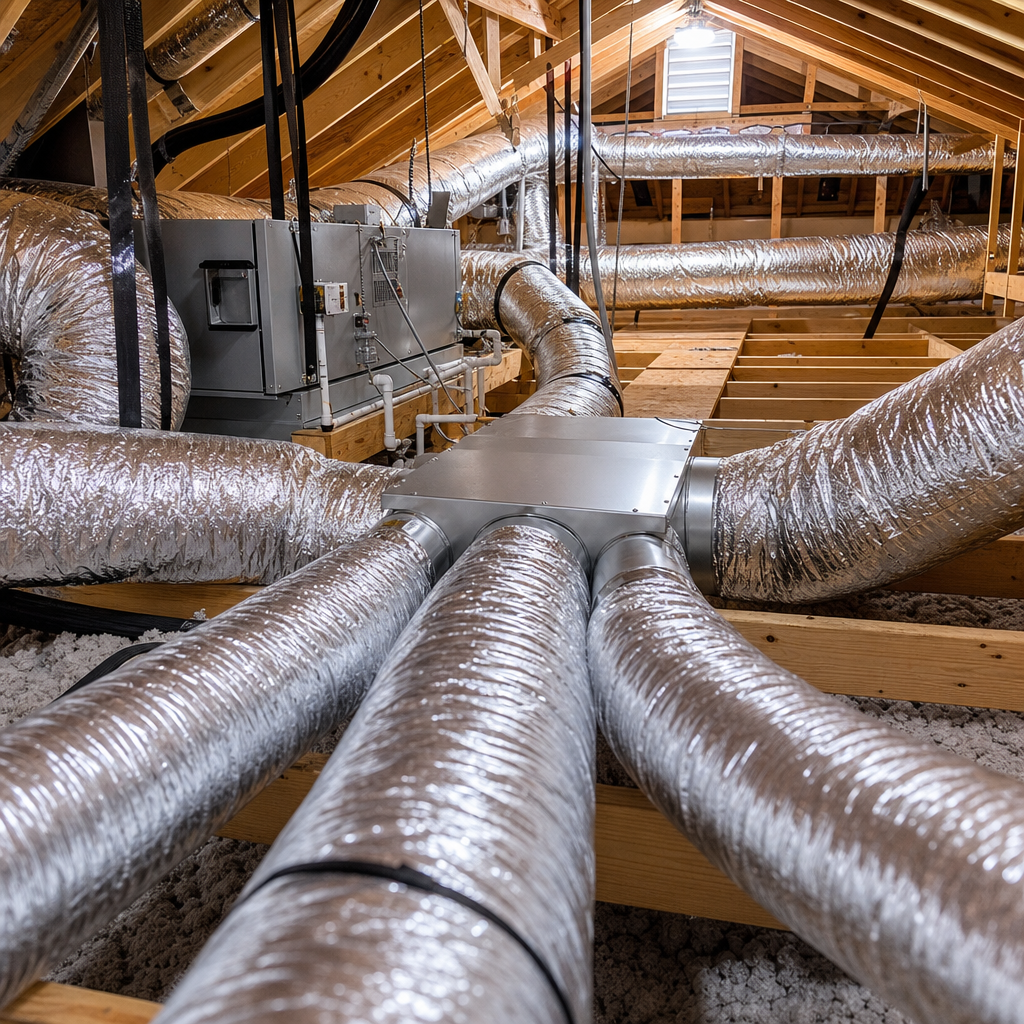
Treating only the vent openings in your ceiling will not address system-wide contamination. Proper service focuses on key areas where moisture and organic matter may accumulate:
Supply and Return Plenums and Flex Ductwork
Attic spaces can reach high temperatures during warmer months. When cooled air passes through flexible ducts and fiberglass-lined plenum boxes, temperature differences can cause condensation. This localized humidity can encourage mold and mildew growth on porous internal insulation. Addressing these main trunk lines helps manage potential microbial growth in the air distribution system.
Evaporator Coils and Blower Wheel Assemblies
The evaporator coil inside the indoor air handler extracts moisture from the air during operation. When fine dust slips past standard air filters, it can stick to damp coil fins and blower blades, creating conditions for microbial buildup and musty odors. Properly cleaning and treating the coil and blower assembly helps reduce biological accumulation at these moisture sources.
What Does Air Duct Sanitizing Cost?
The cost of air duct sanitizing varies across the United States depending on whether the service is an add-on treatment or part of a comprehensive mechanical cleaning. The following figures are general national estimates rather than specific local pricing:[2]
- Sanitizing Add-On (to full cleaning): Adding an EPA-registered antimicrobial treatment to a standard mechanical cleaning generally ranges from $75 to $200 per HVAC system as a broad national estimate.
- Full Mechanical Cleaning plus Sanitizing: A complete service combining mechanical cleaning and antimicrobial application for an average single-family home typically ranges from $450 to $1,000 across the U.S., depending on system size, duct accessibility, and the extent of contamination.
Key Factors That Influence Sanitization Pricing
- Contamination Level: Heavier debris accumulation or suspected microbial growth requires more extensive mechanical agitation and specialized cleaning steps, increasing labor time.
- Duct Material: Rigid fiberglass ductboard and flexible ductwork require different handling and application methods than smooth sheet metal trunk lines.
- Number of HVAC Units: Multi-story homes with separate heating and cooling units require individual equipment setups and treatment for each zone.
Frequently Asked Questions
What chemicals or disinfectants are used to sanitize HVAC ducts?
Any product applied in an HVAC system must be an EPA-registered antimicrobial specifically labeled for use in heating and air conditioning ductwork. Technicians may use conventional disinfectants or botanical-based formulations (such as thymol derivatives), but all products must be used in strict adherence to their EPA label directions and application guidelines.
Is air duct sanitization safe for pets and children?
Safety depends on strict compliance with the EPA product label directions. Any antimicrobial product used must be registered for HVAC applications, and technicians must follow all manufacturer instructions regarding ventilation, application rates, and mandatory reentry guidance before occupants and pets return to the treated area.
How often should residential air ducts be sanitized?
As technicians at Nova Air Duct Cleaning Service Austin explain, air ducts do not require sanitization on a routine schedule. Sanitizing is typically considered only on an as-needed basis, such as after confirmed microbial contamination, localized water damage, or when visual inspection reveals substantial organic growth following mechanical cleaning.
Does duct sanitizing eliminate mold and mildew odors?
Sanitizing may help reduce odor-causing bacteria and fungal residues when applied to clean surfaces in accordance with EPA label directions. However, it is not a guaranteed solution for permanently eliminating odors or preventing future mold growth if underlying moisture sources and physical contamination are not fully resolved.
Need air duct sanitizing in Cedar Park?
We’re available now — call for a fast, free estimate.
Sources
- Air Data – Daily Air Quality Tracker | US EPA – epa.gov (2023)
- [PDF] DOHS Fact Sheet On HVAC Duct Cleaning – ORS – ors.od.nih.gov (2010)
- Research Agenda on Air Duct Cleaning – nepis.epa.gov
- ZIP 78613 Air Quality (AQI) | Cedar Park, TX Real-Time Report – cleanairdata.org
- Membership | National Air Duct Cleaners Association (NADCA) – nadca.com
Air Duct Sanitizing in Nearby Cities
We also serve the communities around Cedar Park:
Frequently Asked Questions
How long does a professional air duct sanitizing service take?
A comprehensive mechanical cleaning paired with air duct sanitizing typically takes between 2 to 4 hours, depending on system size and the number of HVAC units. Nova Air Duct Cleaning Service Austin ensures proper ventilation during application so your household can safely return to normal routines shortly after completion.
How can homeowners prevent mold from returning to sanitized ductwork in Cedar Park?
Preventing future microbial growth requires managing attic humidity, sealing duct leaks, and maintaining clean evaporator coils to eliminate standing condensation. Nova Air Duct Cleaning Service Austin recommends pairing targeted sanitization with routine air filter replacements to keep organic dust from settling on damp HVAC surfaces.
How do I schedule same-day air duct sanitizing in Cedar Park?
You can request a free, no-obligation estimate online or call local technicians directly to secure same-day air duct sanitizing in Cedar Park. Nova Air Duct Cleaning Service Austin evaluates your system to provide an accurate, upfront quote based on duct layout and contamination levels.
About the author
 |
Sarah Jenkins Sarah is an indoor air quality specialist and content writer with over eight years of experience in the HVAC and ventilation industry. Holding a B.S. in Environmental Science from the University of Texas at Austin, she focuses on educating homeowners and property managers about the impact of clean air ducts on respiratory health and system efficiency. Her writing combines technical knowledge with practical advice for maintaining optimal indoor environments. |
Dusty vents or weak airflow at home?
We’re available now — call for a fast, free estimate.
Call Now - Free Estimate