
Quick Summary
Accumulated dirt and biological growth on AC coils severely restrict airflow and inflate utility bills, making professional hvac coil cleaning in Kyle essential for maintaining cooling efficiency. Nova Air Duct Cleaning Service Austin delivers specialized, low-pressure foam cleaning methods that safely eliminate deep debris from indoor evaporator and outdoor condenser coils without causing fin damage. Readers will learn how to identify warning signs of coil fouling and can contact Nova Air Duct Cleaning Service Austin to request a free estimate or schedule a comprehensive system inspection.
HVAC Coil Cleaning in Kyle – Restore AC Airflow Fast
When an air conditioner struggles to cool a home, research shows that dirty coils can significantly reduce system airflow and operating efficiency. Nova Air Duct Cleaning Service Austin provides HVAC coil cleaning to restore system airflow and lower operating strain. Studies by the National Air Duct Cleaners Association (NADCA) show that a complete HVAC system cleaning (including ductwork, coils, blower assemblies, other air-side components, and filter changes) can lower heating and cooling energy use by an average of 11%.[1]
Airborne dust, outdoor pollen, and indoor humidity accumulate on delicate coil surfaces over time. Using high pressure or improper cleaning chemicals can damage thin aluminum fins or drive debris deeper into the coil pack. Professional maintenance relies on low-pressure applications with specialized cleaning agents designed specifically for aluminum coils.
Quick Answer: What You Need to Know
Summary: Professional HVAC coil cleaning removes accumulated dust, particulate residue, and organic growth from indoor evaporator and outdoor condenser coils. Proper cleaning uses fin-safe, low-pressure methods to clear air passages, reduce static pressure, and improve system efficiency without damaging thin aluminum fins.[2]
Coil cleaning removes the insulating layer of grime that prevents an air conditioning system from absorbing heat inside and releasing it outside. When coils are fouled with dirt, the system runs longer cycles, struggles to reach thermostat setpoints, and experiences degraded operating performance.
How Dust and Particulate Accumulation Affect AC Coils
When airborne particulate and construction dust enter an HVAC system, they settle on damp coil surfaces where moisture creates a dense barrier across heat-transfer areas. Note that Kyle-specific limestone claims are not verified by local research data, but general airborne dust and mineral particles are known to foul coils across various environments.[5]
How Fine Particulates Restrict Airflow
Your indoor evaporator coil produces steady condensation as it pulls moisture out of humid air. When dry particulate matter settles onto a damp coil, the moisture binds the particles into a dense layer across the aluminum fins.
Standard over-the-counter foaming sprays frequently make this worse by dissolving only the surface layer, pushing residue deeper into the center of the coil pack where it restricts airflow. Academic research published in Science and Technology for the Built Environment demonstrates that biological growth and fine particulate accumulation cause sharp spikes in airside pressure drop while degrading heat-transfer capacity. As specialists at Nova Air Duct Cleaning Service Austin note, removing this layer requires a dedicated, non-acidic chemical process that lifts deposits without damaging thin metal surfaces.
Dense Fin Packs on Modern AC Units
Modern high-efficiency systems feature dense fin spacing, often packing 14 to 22 aluminum fins per inch. While this design improves energy efficiency under test conditions, it can collect airborne dust more quickly.
Industry research into coil fouling indicates that evaporator coils can foul enough to double airside pressure drop in roughly 7.5 years, a fraction of an air conditioner’s expected operating life. When pressure drop doubles, airflow is restricted and system operating performance declines.
HVAC Coil Cleaning Cost Considerations
Need hvac coil cleaning in Kyle?
We’re available now — call for a fast, free estimate.
Kyle-specific pricing has not been independently verified. Pricing estimates from the nearby Austin area should be used only as rough reference points. Actual costs depend on unit accessibility, coil type, the degree of fouling, and whether the service involves an outdoor condenser or an indoor evaporator located in an attic or plenum space.
Comparing Cleaning Methods
| Service Level | Typical Approach | Buildup Removal Method | Fin Safety Profile |
|---|---|---|---|
| Hardware Store Aerosols (DIY) | DIY retail spray | Pushes debris deeper into center | Safe from high pressure, but leaves residue |
| High-Pressure Washing | Uncalibrated rinse | Fast surface rinse only | High risk of bent fins from excessive pressure |
| Professional Low-Pressure Service | Targeted coil application | Fin-safe chemical foam breakdown | Calibrated low-pressure rinse protection |
Why Evaporator and Condenser Pricing Differs
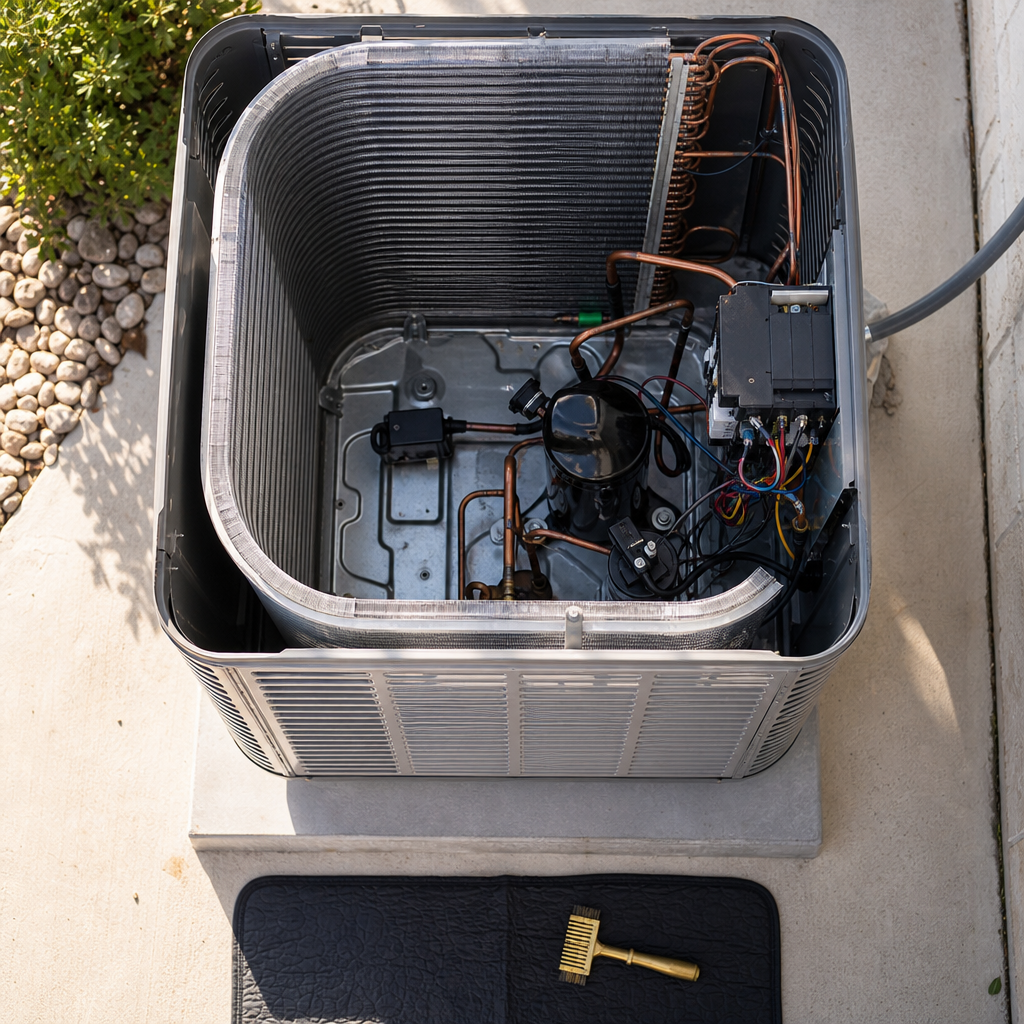
Outdoor condenser coils are exposed to open air, making them straightforward to wash down from the inside out. In contrast, indoor evaporator coils sit inside sealed supply plenums, often above finished ceilings or in tight attic crawl spaces. According to Nova Air Duct Cleaning Service Austin, servicing an evaporator involves opening the cabinet, protecting the overflow drain pan, and carefully treating both the upwind and downwind sides of the coil pack.
Field measurements documented by Taylor & Francis showed airside pressure drops decreasing by 22.70% to 22.72% alongside heat-transfer increases of 13.2% to 13.6% after proper coil remediation. While exact improvements vary based on unit condition and site environment, clearing restricted fins directly improves heat exchange and airflow.[4]
Evaporator vs. Condenser Coils: Different Problems, Different Solutions
Your HVAC system relies on two distinct coils that handle opposite ends of the refrigeration cycle. Treating them effectively requires tailored methods for each environment.
Indoor Evaporator Coils: Moisture, Slime, and Restricted Flow
The evaporator coil operates in a dark, damp environment. As it extracts humidity from your home, dust, pet dander, and microscopic mold spores stick to the wet metal. Over time, this mixture forms a dense biological mat that prevents warm indoor air from reaching the refrigerant lines. When airflow is blocked, the refrigerant cannot boil off properly, causing the coil to freeze into a solid block of ice and completely shutting down cooling.
Outdoor Condenser Coils: Heat, Dirt, and Yard Debris
The outdoor condenser coil expels heat from your home into the outside air. Sitting outdoors year-round, it collects grass clippings, landscape mulch dust, road grime, and seasonal pollen. This layer insulates the coil tubing, preventing the refrigerant from shedding heat. When the condenser cannot cool down, head pressures rise, forcing the system to operate under elevated thermal loads.
Professional Coil Cleaning Methods
Proper HVAC coil maintenance requires appropriate techniques to protect delicate system components.
Low-Pressure Chemical Treatment vs. High-Pressure Fin Damage
Aluminum coil fins are extremely fragile, often less than a millimeter thick. Using standard high-pressure washers can bend the fins and restrict air passage. Research from Oak Ridge National Laboratory shows that restricted air distribution severely degrades overall operating capacity, with performance losses multiplying during peak outdoor temperatures. Professional service from Nova Air Duct Cleaning Service Austin uses low-pressure application systems and non-corrosive foaming detergents to dissolve scale and organic buildup safely.[3]
Inspection and Verification
Borescope inspection cameras can be used to view the interior of the evaporator coil housing before and after service, confirming that fin passages are clear and unobstructed.
Frequently Asked Questions
How much does HVAC coil cleaning cost in Kyle, TX?
Kyle-specific pricing is not verified. Cost estimates from nearby Austin provide only a rough reference point, with outdoor condenser cleanings generally requiring less labor than indoor evaporator coils located in sealed attic spaces.
How often should AC coils be cleaned?
According to Nova Air Duct Cleaning Service Austin, coils should generally be inspected on an annual basis and cleaned based on operating conditions and the rate of visible buildup.
What are the signs that my HVAC coils are dirty and need service?
Common warning signs include weak airflow from supply vents, rooms that stay warm, ice forming on indoor copper lines or the evaporator cabinet, musty odors when the blower kicks on, and unexplained increases in utility bills.
Can dirty AC coils increase energy bills and reduce cooling performance?
Yes. When dirt insulates the coil surfaces, the heat-exchange process slows down significantly. The compressor and blower fan must run longer cycles to reach the temperature set on your thermostat, increasing electrical consumption.
What is the difference between evaporator coil and condenser coil cleaning?
Evaporator coil cleaning focuses on removing damp biological growth, mold, and indoor dust from inside the air handler cabinet. Condenser coil cleaning addresses outdoor grime, baked-on dirt, grass clippings, and pollen on the exterior unit to ensure proper heat rejection.
How long does a professional HVAC coil cleaning service take?
A standard single-system cleaning typically takes roughly 60 to 90 minutes, though systems with heavy buildup, deep organic fouling, or difficult attic access may require additional time.
Need hvac coil cleaning in Kyle?
We’re available now — call for a fast, free estimate.
Sources
- Dirty Air Conditioners: Energy Implications of Coil Fouling – osti.gov
- Energy Consumption Characteristics of Commercial Building … – www1.eere.energy.gov
- THE ROLE OF FILTRATION IN MAINTAINING CLEAN … – osti.gov
- Energy and Economic Impacts of Ultraviolet Germicidal … – etda.libraries.psu.edu
- Science and Technology for the Built Environment feature … – ashrae.org (2017)
Hvac Coil Cleaning in Nearby Cities
We also serve the communities around Kyle:
- Hvac Coil Cleaning in Austin
- Hvac Coil Cleaning in Anderson Mill
- Hvac Coil Cleaning in Bastrop
- Hvac Coil Cleaning in Bee Cave
- Hvac Coil Cleaning in Brushy Creek
- Hvac Coil Cleaning in Buda
- Hvac Coil Cleaning in Camp Swift
- Hvac Coil Cleaning in Cedar Park
Frequently Asked Questions
Why can DIY chemical sprays cause more harm than good to indoor AC coils?
Over-the-counter foaming sprays often melt only surface-level grime, pushing dissolved residues deeper into dense 14-to-22 fin-per-inch packs where they solidify into an airflow barrier. Nova Air Duct Cleaning Service Austin prevents this by using professional-grade, non-acidic chemical foam paired with calibrated low-pressure rinsing that lifts debris out without bending fragile aluminum fins.
How does a dirty evaporator coil lead to a frozen air conditioning system?
When dirt and biological buildup insulate the evaporator coil, indoor heat cannot transfer efficiently into the refrigerant lines. This causes internal coil temperatures to plummet below 32 degrees Fahrenheit, turning normal condensation into a solid block of ice that chokes off airflow until treated by Nova Air Duct Cleaning Service Austin.
How do technicians verify indoor coil cleanliness inside sealed attic plenums?
Technicians at Nova Air Duct Cleaning Service Austin use high-resolution borescope inspection cameras to inspect deep within sealed plenum cabinets and between dense fin banks. This allows homeowners to visually verify that deep dust, mold, and biological mats have been eliminated on both the upwind and downwind sides of the coil pack.
About the author
 |
David Miller David is a certified HVAC technician and indoor air quality specialist with over 15 years of experience serving the Austin community. He holds an associate degree in Heating, Ventilation, and Air Conditioning Technology from Austin Community College. David frequently shares his expertise on residential and commercial ventilation maintenance, emphasizing safety and system efficiency. |
Dusty vents or weak airflow at home?
We’re available now — call for a fast, free estimate.
Call Now - Free Estimate