
Quick Summary
Effective air duct sanitizing in Round Rock requires complete mechanical particulate extraction before applying treatments to prevent chemical mists from forming sludge with local limestone dust and seasonal allergens. Nova Air Duct Cleaning Service Austin solves this challenge with an owner-led, mechanical-first approach that uses rotary brushing and negative-air extraction to neutralize mold spores and odors safely. Homeowners will understand key EPA guidelines on HVAC sanitization and can contact Nova Air Duct Cleaning Service Austin to request a free estimate for same-day service.
Air Duct Sanitizing in Round Rock – Professional HVAC Care
For air duct sanitizing in Round Rock to address musty odors, mold spores, and persistent system buildup, Nova Air Duct Cleaning Service Austin delivers targeted treatments only after complete mechanical debris removal.
Central Texas humidity combined with fine, chalky limestone dust creates unique challenges for residential flex ductwork. While discount handymen and blow-and-go operators often fog chemical sprays directly into dusty registers, owner Douglas Ross uses a mechanical-first approach. We use Rotobrush contact vacuuming paired with high-velocity Nikro negative-air extraction to pull out settled dust before applying sanitizing agents. Under the verified limited-duct-cleaning exemption of Texas Chapter 1302, our non-invasive cleaning process works through existing supply registers without cutting into system plenums or altering mechanical and electrical lines.
Contact Nova Air Duct Cleaning Service Austin to schedule a thorough assessment of your home’s ductwork.
Quick Answer: How Air Duct Sanitizing Works
Summary: Air ducts usually do not need cleaning except in limited cases such as visible mold, vermin infestation, or heavy debris. Furthermore, the EPA generally discourages routine duct sanitizing unless the product is specifically labeled for HVAC use and the situation warrants treatment. Any sanitizing product must be specifically registered and labeled for HVAC use and applied only after thorough mechanical cleaning of precleaned, non-porous surfaces. Skipping the physical vacuuming step wastes money and creates sticky buildup inside your vents.[2]
Why Mechanical Cleaning Must Come Before Sanitizing in Round Rock Flex Ducts
Sanitizing sprays cannot penetrate thick blankets of settled dirt and pollen. If a contractor fogs a dirty system, the antimicrobial mist simply settles on top of the debris instead of reaching the inner duct liner, leaving active mold or bacteria undisturbed underneath.
The Real Risk of Fogging Over Central Texas Limestone Dust
Round Rock homes deal with high volumes of airborne limestone dust from regional quarrying and continuous neighborhood construction, mixed with heavy seasonal cedar and oak pollen. Inside the spiral wire ridges of flexible ducting, this fine particulate settles into thick layers.
When an unspecialized contractor sprays a liquid aerosol into dirty ducts, that moisture binds with the dry limestone powder, creating a heavy, sticky paste along the bottom of the flex duct. This residue does not just trap fresh allergens; it hardens over time, narrows the duct diameter, restricts airflow to your rooms, and forces your blower motor to work harder during peak summer heatwaves.
Nova Air Duct Cleaning Service Austin prevents this by focusing on thorough particulate extraction. Our technicians run rotary brush systems deep into each branch run while Nikro negative-air units pull all loosened dust and pollen out of the home before any sanitizing mist is introduced.
EPA Rules on HVAC Sanitization and Surface Contact
The U.S. Environmental Protection Agency generally discourages routine duct sanitizing unless the product is specifically labeled for HVAC use and the situation warrants treatment, such as active biological growth or severe odor following water intrusion. Ducts usually do not need cleaning except in limited cases such as visible mold, vermin infestation, or heavy debris.[3]
Any sanitizing product must be specifically registered and labeled for HVAC use and applied only after thorough mechanical cleaning of precleaned, non-porous surfaces. When evaluating duct sanitizing services in Round Rock, always confirm that your technician performs complete source extraction first. Applying sanitizers to a clean surface ensures the treatment works effectively without leaving chemical residues behind.[1]
HVAC Components Treated During Complete System Service
Need air duct sanitizing in Round Rock?
We’re available now — call for a fast, free estimate.
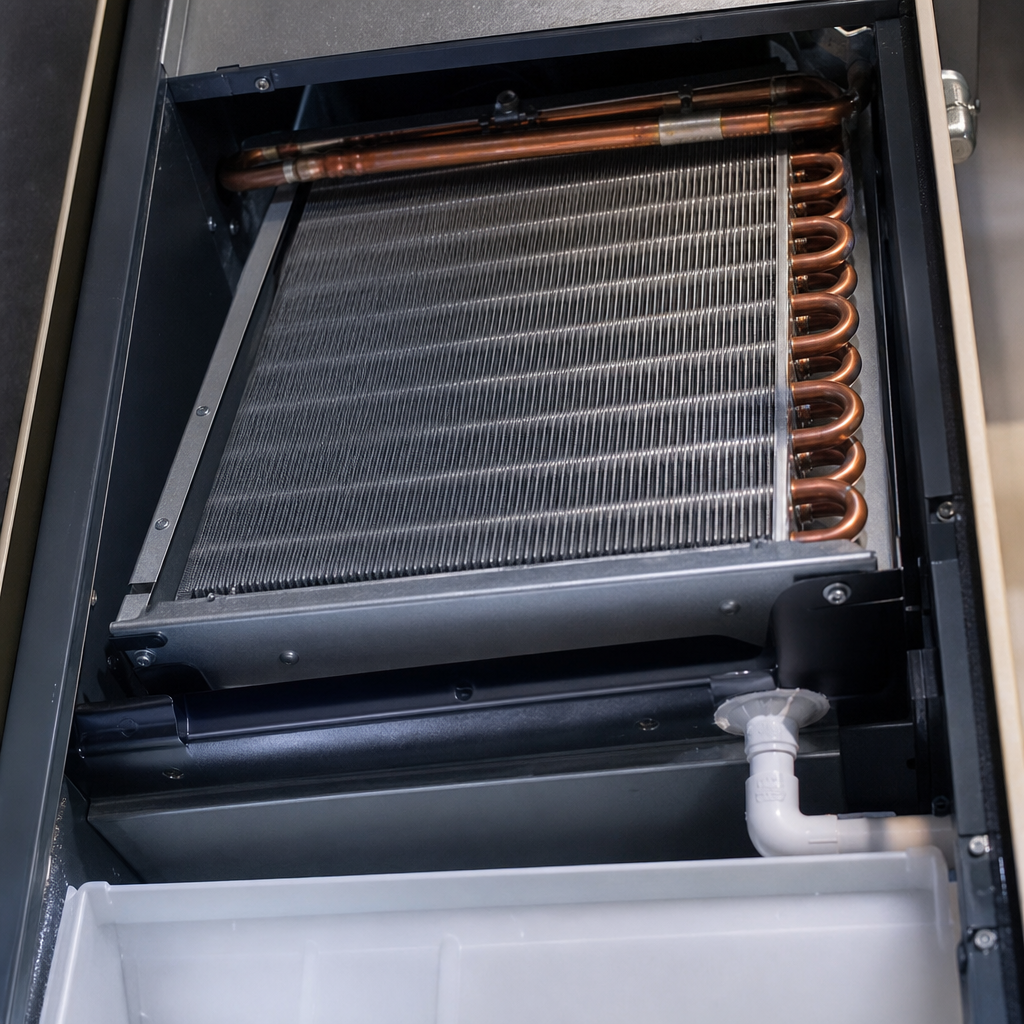
Treating only the vent covers or accessible register boots leaves the real source of system contamination untouched. A proper treatment covers every critical point along the air stream:
Evaporator Coils and Condensate Drain Pans
During humid Texas summers, air conditioner cooling coils are constantly wet from condensation. The National Air Duct Cleaners Association (NADCA) notes that bio-growth on wet evaporator coils can reduce system airflow efficiency by up to 30 percent. Technicians clean and treat the coil fins and drain pans directly to stop musty odors where moisture naturally collects.
Flexible Supply and Return Runs
The corrugated inner walls of residential flex ducts catch pet hair, dander, and dust mites. Technicians run soft-bristle rotary brushes through each branch to clear out the ridges before applying any fine mist treatment, keeping the flexible core clean without tearing the inner plastic jacket.
Plenum Boxes and Blower Motor Assemblies
Central junction boxes and blower fans in systems from manufacturers like Trane, Carrier, Lennox, and Goodman circulate all the air your family breathes. When fine dust accumulates on the blower wheel fins or inside the supply plenum insulation, it blows musty air across the entire house. Cleaning these components restores balanced air output and stops recurring odors at the source.
Evaluating Air Duct Sanitizing Options in Round Rock
Understanding what goes into a professional cleaning helps you avoid common industry pitfalls and low-quality contractors.
Comparing Service Methods
| Feature | Aerosol Fogging Only | Mechanical Vacuuming Only | Mechanical Extraction + Targeted Sanitizing |
|---|---|---|---|
| Particulate Extraction | No | Yes | Yes |
| Treats Odors & Microbes | Temporarily (masks odors) | Partially (removes food source) | Yes (neutralizes spores on clean surfaces) |
| Risk of Duct Sludge | High | None | None |
| EPA Guideline Compliant | No | Yes | Yes |
Factors That Influence Service Scope
According to NADCA industry standards, the time and effort required to treat a duct system depend on the total number of supply and return vents, overall system accessibility, whether the home has one or multiple air handlers, and the severity of dust or biological buildup. Nova Air Duct Cleaning Service Austin provides clear, transparent evaluations upfront so you know exactly what your system needs to run cleanly and efficiently.
Frequently Asked Questions
When is duct cleaning and sanitizing actually necessary?
According to EPA guidelines, ducts usually do not need cleaning except in limited cases such as visible mold inside the vents or on mechanical components, vermin infestation, or heavy debris restricting airflow. The EPA generally discourages routine duct sanitizing unless the product is specifically labeled for HVAC use and the situation warrants treatment. Any sanitizing product must be specifically registered and labeled for HVAC use and applied only after thorough mechanical cleaning of precleaned, non-porous surfaces.
Is air duct sanitizing safe for pets and children?
Yes, provided the technician uses a product specifically registered and labeled for HVAC use and follows the manufacturer’s exact label directions. Reputable products break down into harmless components without leaving lingering chemical vapors. Technicians will advise you on standard ventilation steps and any label-directed re-entry wait times before turning the system back on.
What is the difference between duct cleaning and duct sanitizing?
As explained by Nova Air Duct Cleaning Service Austin, air duct cleaning is the physical removal of dust, dirt, pollen, and debris using mechanical brushes and negative-air vacuums. Duct sanitizing is a secondary treatment applying an antimicrobial solution to precleaned, non-porous surfaces when warranted. Sanitizing is not a standard service and should never replace physical cleaning.
Need air duct sanitizing in Round Rock?
We’re available now — call for a fast, free estimate.
Sources
- Use of Disinfectants and Sanitizers in Heating, Ventilation … – epa.gov (2002)
- Draft PRN 2006-A: Use of Antimicrobial Pesticide Products in … – EPA – epa.gov (2006)
- [PDF] DOHS Fact Sheet On HVAC Duct Cleaning – ORS – ors.od.nih.gov (2010)
Air Duct Sanitizing in Nearby Cities
We also serve the communities around Round Rock:
- Air Duct Sanitizing in Austin
- Air Duct Sanitizing in Anderson Mill
- Air Duct Sanitizing in Bastrop
- Air Duct Sanitizing in Bee Cave
- Air Duct Sanitizing in Brushy Creek
- Air Duct Sanitizing in Buda
- Air Duct Sanitizing in Camp Swift
- Air Duct Sanitizing in Cedar Park
Frequently Asked Questions
How long does a mechanical cleaning and air duct sanitizing service take in Round Rock?
For a standard single-system home, the complete source extraction and sanitizing process typically takes between two and four hours. Nova Air Duct Cleaning Service Austin completes thorough rotary brushing and negative-air extraction before applying sanitizers, ensuring complete, same-day service without cutting into duct plenums.
How does professional duct sanitizing help with Central Texas cedar and oak pollen?
Mechanical extraction clears out heavy pollen and limestone dust trapped along flexible duct ridges, while targeted sanitizing neutralizes lingering organic spores and musty odors. Nova Air Duct Cleaning Service Austin uses this two-step method to stop trapped seasonal allergens from continually recirculating through your home.
How soon can I run my HVAC system after an air duct sanitizing treatment?
Most EPA-registered HVAC sanitizing mists require a brief drying and ventilation period of 30 to 60 minutes before the system is turned back on. Technicians from Nova Air Duct Cleaning Service Austin follow exact product label guidelines to ensure proper ventilation so your family can safely enjoy cleaner indoor air right away.
About the author
 |
Sarah Jenkins Sarah is an indoor air quality specialist and content writer with over eight years of experience in the HVAC and ventilation industry. Holding a B.S. in Environmental Science from the University of Texas at Austin, she focuses on educating homeowners and property managers about the impact of clean air ducts on respiratory health and system efficiency. Her writing combines technical knowledge with practical advice for maintaining optimal indoor environments. |
Dusty vents or weak airflow at home?
We’re available now — call for a fast, free estimate.
Call Now - Free Estimate